Looking for a Personal Trainer for Menopause in Gloucester County, NJ? Here’s What Matters
The right coach should do more than encourage you. Your training plan should reflect your goals, recovery, joint comfort, current strength, and the physical changes that can happen during perimenopause and menopause.
The short answer: A good menopause-aware training program prioritizes progressive strength work, adjusts intelligently when sleep or symptoms affect recovery, tracks more than scale weight, and stays within any guidance provided by your physician. At Thrive Fitness in Mickleton, we use coaching, individualized adjustments, and progress tracking to help members build strength with confidence.
Menopause should change the conversation—not eliminate challenging training
During perimenopause and menopause, many women notice changes in energy, sleep, body composition, joint comfort, and recovery. Those changes can make an old workout routine feel less effective or harder to sustain.
The answer is rarely to stop challenging yourself. It is to train with a clearer plan.
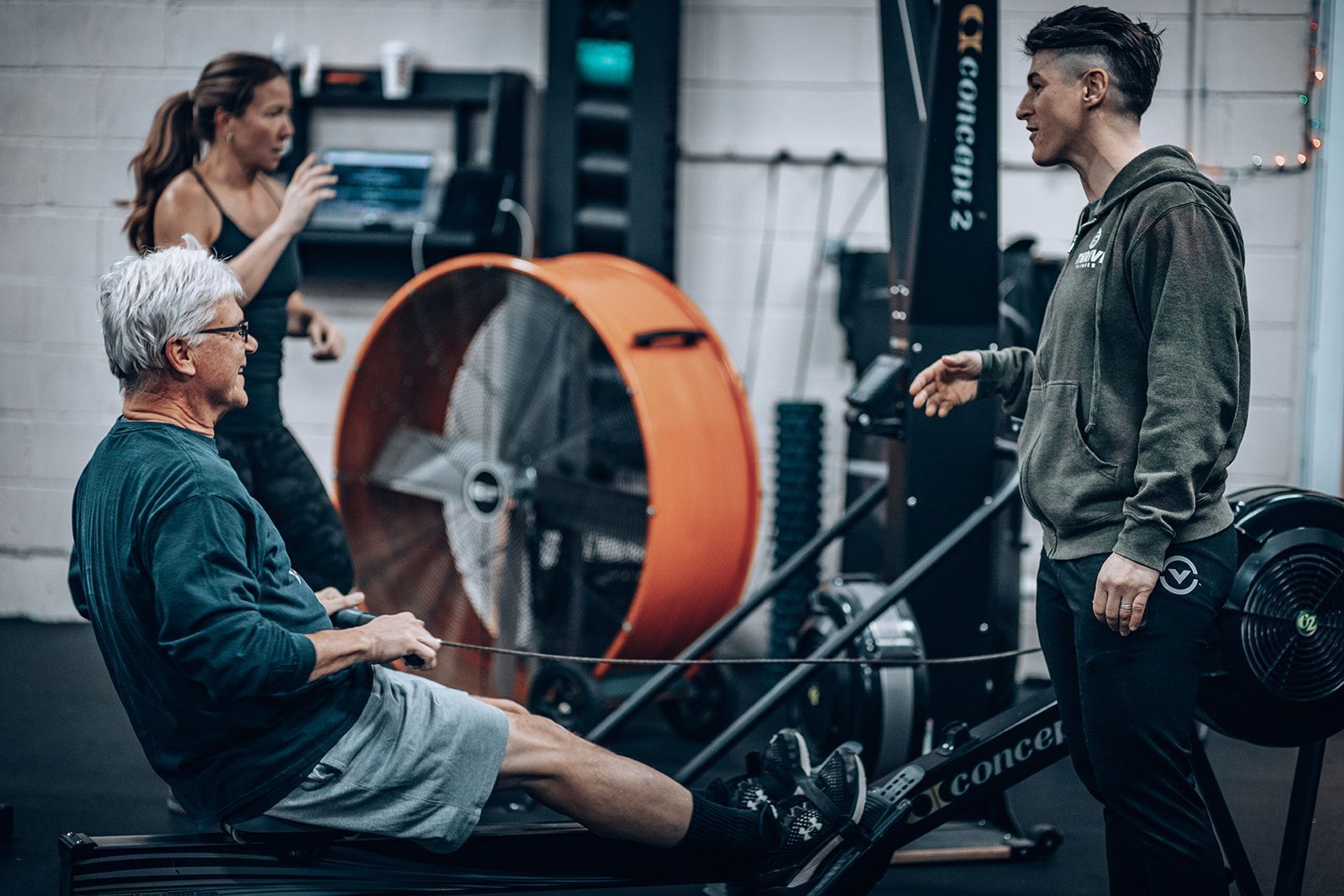
A qualified coach should know how to progress strength safely, adjust exercise selection when something does not feel right, and manage training volume when recovery is temporarily lower. Your program should still move forward, but it should move forward from your current starting point.
Four things to look for in a menopause personal trainer
1. A real strength progression
Your sessions should include resistance training that becomes appropriately more challenging over time. That might mean increasing the weight, adding repetitions, improving technique, expanding range of motion, or progressing to a more demanding variation.
Strength training helps preserve and build muscle, supports everyday function, and provides an important stimulus for bone. The Bone Health & Osteoporosis Foundation identifies both weight-bearing and muscle-strengthening exercise as important for maintaining bone health. Read its exercise guidance here.
2. Progress measured beyond the scale
Scale weight is only one piece of information. A useful progress review can also include strength, energy, consistency, measurements, how clothing fits, movement quality, and body-composition data when appropriate.
Someone can become stronger, add muscle, and reduce body fat without seeing a dramatic change in total body weight. At Thrive, InBody scans can be used alongside performance and habit tracking to give members a fuller picture of their progress.
3. Recovery that can be adjusted
Poor sleep, hot flashes, stress, and an unusually demanding week can affect how ready you feel to train. A good coach does not treat every session as all-or-nothing. The workout can be adjusted while still preserving the habit of showing up.
That may mean reducing load, changing the exercise, lowering the number of sets, or choosing a steadier conditioning option. Smart adjustments keep one difficult week from turning into a month away from training.
4. Exercises that work with your body
Knees, hips, shoulders, and backs do not all respond to the same exercises in the same way. Your coach should be able to modify stance, range of motion, equipment, tempo, and loading without making you feel as though you have failed the workout.
If you have osteoporosis, a previous fracture, pelvic-floor symptoms, significant pain, or another medical concern, speak with the appropriate healthcare professional before beginning or changing your program. The goal is to train productively inside the guidelines that are right for you.
A useful question to ask any trainer:
“What would you change about my training based on my goals, symptoms, recovery, and current ability?”
A strong answer should include specific programming decisions. If the entire answer is simply “burn more calories,” keep asking questions.
Where your physician fits
Your coach and physician have different jobs. Questions about hormone therapy, bone-density testing, unexplained symptoms, medication, and diagnosis belong with a licensed medical professional. A trainer should never promise to treat or “fix” menopause.
Training contributes something different: progressive resistance, movement practice, cardiovascular fitness, coaching, and a consistent routine. The best results come when your medical care and fitness plan support one another.
Which type of training is the best fit?
There is no single format that every woman needs. At Thrive Fitness, the right starting point depends on how much individual attention you want and how specific your needs are.
Personal training
One-on-one coaching is a strong choice if you want a plan built entirely around your goals, schedule, training history, injuries, or limitations.
Semi-private training
Semi-private training provides individualized programming and close coaching in a small setting. It works well for people who want personal attention with added community and energy.
Group training
Group training provides structured strength and conditioning with a coach leading the session. Exercises can be adjusted to meet your current ability while you train alongside a supportive community.
Menopause fitness coaching near Mickleton, Mullica Hill, and Swedesboro
Thrive Fitness is located at 411 Southgate Court in Mickleton, New Jersey. We work with members from East Greenwich, Mullica Hill, Swedesboro, Woolwich, Mount Royal, Clarksboro, and throughout Gloucester County.
You do not need previous lifting experience before you begin. Your coach can help you choose an appropriate training option, learn the movements, and build from a realistic baseline.
Frequently asked questions
Can exercise eliminate menopause symptoms?
Exercise can support strength, bone health, cardiovascular health, body composition, mood, and daily function, but a trainer should not claim that exercise will eliminate menopause symptoms. Discuss persistent or concerning symptoms with your healthcare provider.
Is it too late to begin strength training after menopause?
No. Strength training can be scaled to your current ability and progressed over time. Starting with appropriate exercises and coaching is more important than starting at a particular age.
What if my joints hurt?
Pain deserves attention. A coach can often modify exercises, loading, and range of motion, but persistent, worsening, or unexplained pain should be evaluated by an appropriate healthcare professional.
Do I need personal training?
Not necessarily. Some people benefit from one-on-one coaching, while others do well in semi-private or group training. We can help you choose based on your goals, experience, comfort, and preferred level of support.
See if Thrive feels right for you
Your first week is free. Come meet the coaches, experience a session, and see which training option fits you best.
START YOUR FREE WEEKThrive Fitness · 411 Southgate Court, Mickleton, NJ 08056 · (856) 746-4955